
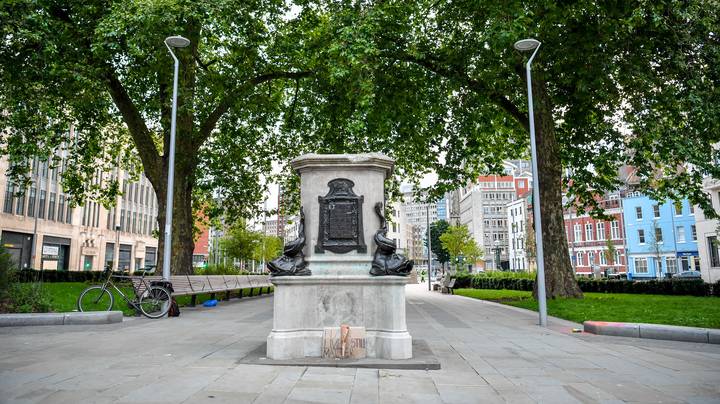
I’ve not been able to write anything worth self-publishing about the case of the self-styled ‘Colston 4’. God knows – well, God doesn’t exist but you know what I mean – I have tried and abandoned at least three blogs, maybe more, but it’s just not there. Until now. I suppose it could be that my position is a bit woolly. I welcome the fact that Colston’s statue is no longer on display but I don’t welcome the fact that Bristolians weren’t consulted about its removal. I’m not sure if it changes much, either.
I’ve known what kind of man Edward Colston was since I was a young boy. I knew he was admired as a generous philanthropist but I also knew his philanthropy came about because of his heavy involvement in slavery. The former meant nothing because of the latter. But somehow there was a silent acceptance that the statue was there for better or for worse. It was part of our history, warts and all.
I attended countless political events in Bristol, addressed by politicians like Tony Benn, campaigners from Bristol’s black community and even actual members of the African National Congress at a time when Nelson Mandela was on Robin Island. Slavery was often mentioned, but Colston’s statue never was.
My initial thoughts about Colston’s statue and all the other places and streets named after him was that you could not, indeed should not, attempt to rewrite history and that the name should remind of an uncomfortable past. In more recent times, I came to accept that I was wrong, that instead you should have the grim history of slavery in a museum but not on a plinth.
One of the Colston 4, Rhian Graham, said the not guilty verdict was not about her, or the other three defendants. “It’s about Bristol,” she said, “And it’s a win for the people of Bristol. It’s another step along the way towards racial justice.” But it was about her and Milo, Sage and Jake. She wasn’t acting on my behalf or anyone else’s. And I can’t see, for the life of me, how a simple court verdict is “another step along the way towards justice”. And here I offer full disclosure.
In the 1970s and early 1980s, I marched with the Labour Party and the Anti Nazi League, often picketing events called by the fascist National Front. I actively supported Rock Against Racism. I was a member of the Anti Racist Alliance for many years. I was a member of the Anti Apartheid Movement. I ran anti-racism courses on behalf of my trade union for many years. I support Black Lives Matter. Actually, it’s probably not full disclosure. There may be more stuff I can’t remember. I don’t pretend to be perfect on the subject but I have a lifelong opposition to racism which only deepens with each passing year. Despite all that, I am not convinced that toppling Colston’s statue will change anything.
Okay, there’s the symbolism, I get that. But the structural and institutional racism of our society, whilst weakened over the years, still exists. Add to that, Bristol’s widening equality as the city changes and local people are squeezed out of the areas in which they live because they can’t afford to stay there. In my opinion, we need much more than a broken statue to change Bristol for the better.
As for the future, I hope this time the people of Bristol are genuinely consulted. Should another statue be erected and if so of who? I have come to the conclusion that now Colston’s statue has gone, the plinth should go with it. Just put a plaque on the ground where the statue once stood.
“I hope this outcome has given a platform to the people in Bristol who have been fighting this battle far longer than I have,” adds Ms Graham. “The city has a clear duty now to reckon with its past and set up memorials or museums to the slave trade, and recognise that so much of the prosperity enjoyed today in the UK and Bristol comes off the back of historical atrocities.” Woah. Hang on a moment.
The people of Bristol have not really been fighting “this battle” for long at all. It was only in recent times when petitions were set up calling for Colston’s statue to be removed. That is not to say Bristol has especially wanted to retain the statue; it’s just that many people simply didn’t think about it. Yes, yes, we know that some of Bristol’s prosperity occurred off the back of “historical atrocities” but some of us have long reckoned with the city’s past and what happened in the 17th century was not something over which we had any responsibility or influence. Although I am a Bristolian born and bred, my ancestors were not. I simply say this to Ms Graham: you describe yourself as a ‘stage manager and a facilitator’. Why not involve your energies in helping to set up these memorials and museums? You pulled down a statue which we can agree shouldn’t have been there in the first place. How about facilitating change yourself? There is nothing worse than saying “Something must be done” and then waiting for someone else to do it.
Bristol is far from united over the toppling of Colston’s statue. Only if the people of the city are involved in what comes next can we possibly unite. Is that what everyone really wants? I’m not sure about that.

1 comment
5
Comments are closed.