
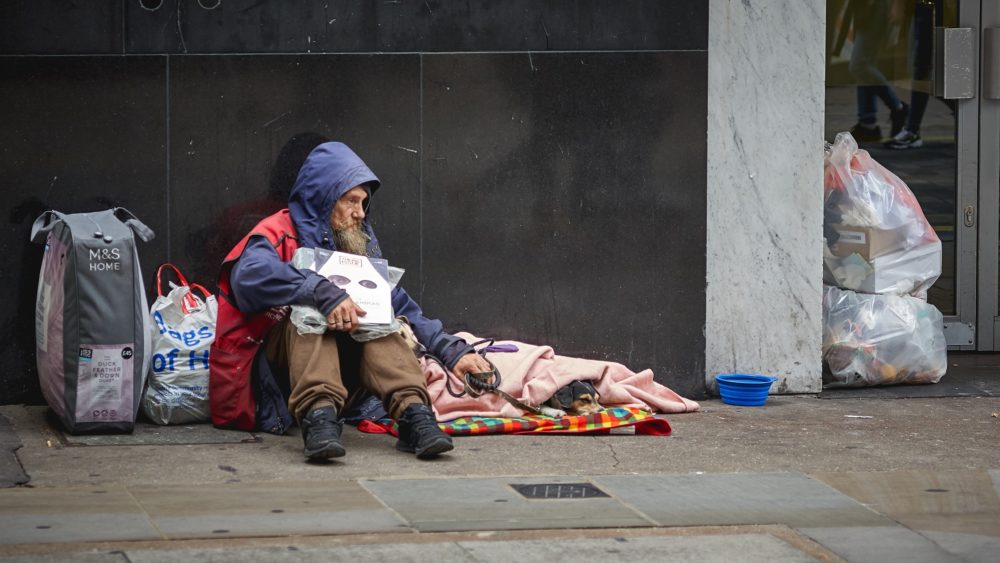
When I read and hear about the 14 million people living in poverty in our country, it takes me back to my childhood. Like many people of my generation, my family was very poor. I lived with my mother in a rickety and relatively large three-bedroomed house that we could not afford to heat. Again, like many people of the time, we had no fridge. We lived from day to day. If it had not been for the generosity of my father Anthony, by then living across the pond in Canada, we would certainly have lost our house and been homeless. When I read and hear the stories today, I genuinely feel their pain. I have walked in their threadbare shoes.
My mother, Elly, worked ridiculously long hours to keep us, if not warm, then fed. Every day, after work, she would go to Josef Packaert’s butcher shop on Nelson Street just before he closed. She would see if there were any off cuts, or pieces of meat that were about to go off, that she might pick up at reduced price. Sometimes she was lucky, other times she wasn’t. When she was lucky, we might have some pig’s liver or a pork chop. She would peel some potatoes and either boil them or make chips. If she had been unlucky, it might be bread and jam for tea, or even bread and sugar. No wonder I now how more fillings and caps than teeth.
I never thought this unusual. Perhaps, I concluded, this was normal, whatever normal was. When visiting the houses of neighbours, I noted they were always warmer and lighter than ours, they had telephones and cars on the drive, hostess trolleys and neat little holes in the wall between the kitchen and the dining room to pass through items of food.
My paternal grandfather and grandmother, Alfred and Nellie, lived about three quarters of a mile away. They had an outside toilet covered by an erstaz plastic-covered ‘extension’ and no bathroom at all. And, like my mum, existed on a diet of offcuts and, from what I could gather, biscuits and pikelets. No one ever came to visit them and I certainly never remember a neighbour calling by, although I knew them to say hello to. I’d say we were poor but either not ashamed of it, or good at pretending to others we weren’t.
In a previous job, I took people to food banks. It was, at first, a deeply uncomfortable experience. I was with people, often older people, who had to choose between eating and heating and sometimes could afford to do neither. You do not just turn up at a food bank and get handed a box of food; you have to prove you need it. My heart ached as I heard people forced out of necessity to open their hearts and admit their poverty.
Many of these people, in the 21st century, had no fridges, just like us in the 1960s. There was no point in giving them perishables. Best to have things that could be eaten without the requirement to cook it because the electricity had been cut off or they couldn’t afford to feed the meter. I knew all about the electric meter, of switching everything off in case there was nothing left for the morning. In a world of technology that seemed impossible even thirty years ago, we were seeing people having to, as they often put it, beg.
Walk through Bristol’s city centre and you don’t have to look hard to find the terrible inequalities that surround us. The drug addicts and the drunks, the homeless and the needy; the people that society left behind.
My Christmas presents, apart from those afforded by my father Anthony, like my beloved train set and my pedal car, were socks to replace those that my mother could no longer darn and trousers to replace those that could no longer be patched. Make no mistake, this is today’s world, too.
We so need a better way to live than this. We need far more than a new government every five years. We need a change of mindset, of mentality; the beginning of a kinder, better place, one where we don’t walk by on the other side when we see someone else’s tragedy unfolding, where we whinge on social networks about homeless ex service personnel and do literally nothing, either individually or collectively, to help them. We are okay. Something must be done but only by someone else.
I know how it feels to be waiting at the table and wondering what you would be having for tea, whether it was the luxury of some pig’s liver or even a tired looking pork chop or just a sandwich.
I was lucky to escape poverty. It wasn’t by design or anything. I was just lucky. Many things in life passed me by and now I see it all happening again for 14 million – 14 million – people in our country in the 21st century.
Having nothing, or like us, next to nothing leaves huge scars and in my case enormous chips on both shoulders. I wish more than anything that no one else should feel like that. Poverty is not the choice of the poor, it’s the choice of society, especially those who believe there is no such thing as society. And believe me, there are plenty of people like that.
My past, and a far worse version of it, is the plight of millions today and potentially many millions more tomorrow. In the season of greed and decadence, AKA Christmas, do enough people really care?
