
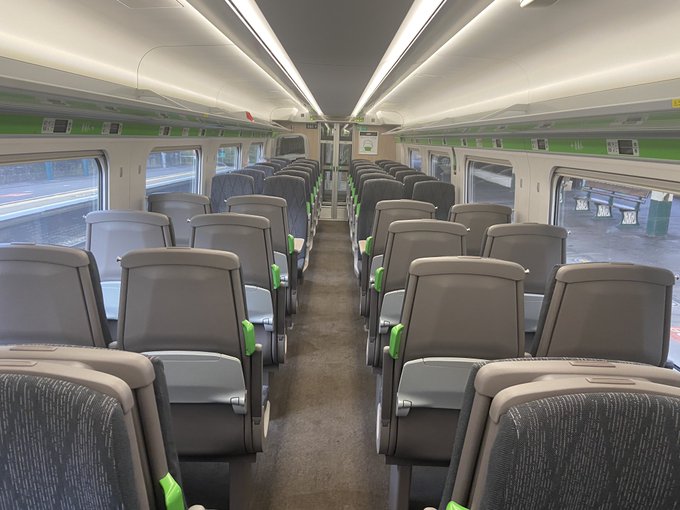
The above photograph was tweeted today by Fraser Nelson, the right wing editor of the right wing Spectator magazine. It shows the inside of a carriage on a peak hour train from Bristol (he doesn’t say which station – looks like Temple Meads to me) to London and there’s no one on it. We know why this is: the people who’d have normally used this service are either working from home, are furloughed or unemployed because of COVID-19. ‘Do not travel on public transport,’ said the government. Walk, cycle or drive. Five months on since lockdown began, people aren’t going back to the train. No one should be surprised.
Companies have realised that rather than pay extortionate train fares to enable their employees to waste hours every day crushed on a train, they can do the same job from home at a fraction of the cost. The days of ‘I’m to London for a meeting’ are well and truly over and they’re never coming back.
Being an opportunist, I decided it would be good to travel next week on an otherwise empty train to the capital for a day’s sight-seeing. With next to no one using the expensive Hitachi trains on the main line to London, I put a few dates in expecting to find a few bargains. Dear oh dear. It turns out that despite no one using trains, old fares still apply. So, a peak hour day return would set me back nearly £225. It’s almost as if the people who run the railways – that’s the government at the moment – literally want to get rid of them altogether. I might have considered up to £50, which I would still see as a hefty sum just to get a train that was going to its destination with or without me. My imagined £50 would be £50 more than they’d otherwise be getting, but no: if the richest people aren’t travelling, whatever you do, don’t encourage the riff-raff like me.
For many years, the preserve of the railways, particularly the inter city services, or whatever they are called nowadays, has been the upper middle classes who can afford the fares because either they earn a shed load of money or, more often, their companies pay the money. On the few occasions I have let the train take the strain to London, I have half-expected upper class businessmen to complain to the conductor about the lower orders like me entering their space.
As things stand, trains look like they belong in the past and if, as seems likely, this awful virus hangs around for the foreseeable and indeed unforeseeable future, I suspect vast swathes of the network are either going to be mothballed or shut down completely.
Covid-19 seems to have finally exposed the reality of a rail network that exists mainly to suit the lavish lifestyles of the affluent middle classes. Those of us who believed rail travel should be a public service lost that argument years ago. And in a few years time, Julia Bradbury will be presenting a new TV series of lost railway lines: “This week we’ll be walking from Bristol to London and learning about where the Great Western Railway used to be until COVID-19 came along.”
