
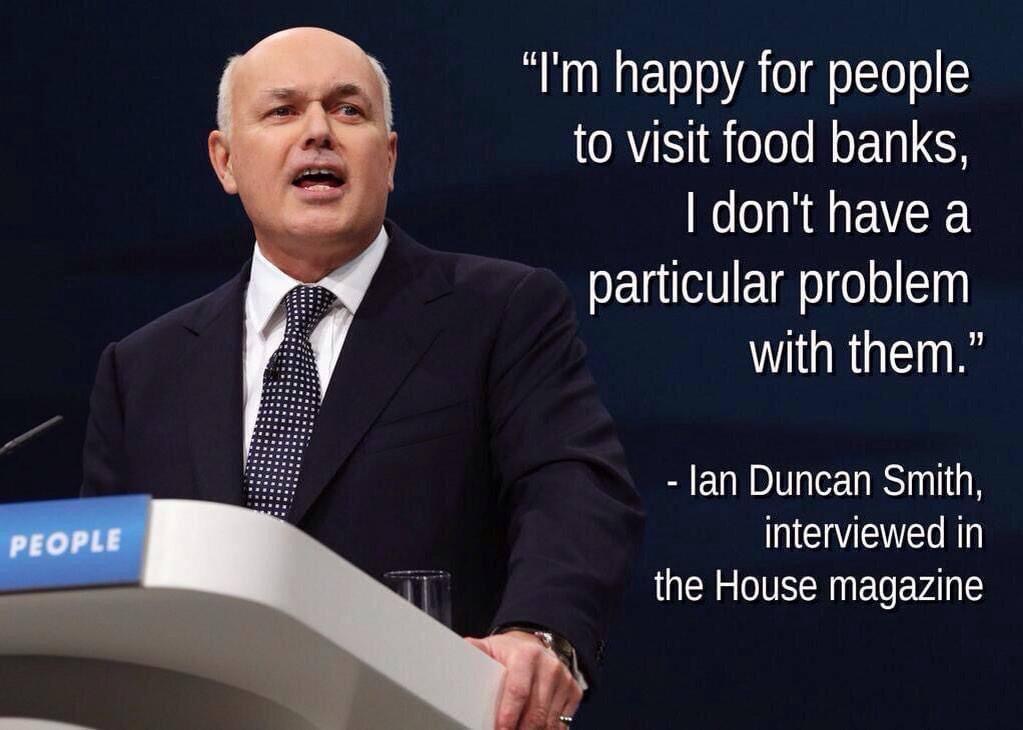
Ahead of this week’s food bank day, I remember Iain Duncan Smith’s comments, photo above, about how happy he is that people visit food banks. Perhaps, his comments have been reported ‘out of context’ or he actually meant he’d be happier if people went to a food bank and ate something rather than starve to death. And let no one get away with saying that IDS has no idea what it’s like to go without food when evidence has been uncovered showing him enjoying a light snack from the contents of his nose. This is a man who understands food poverty.
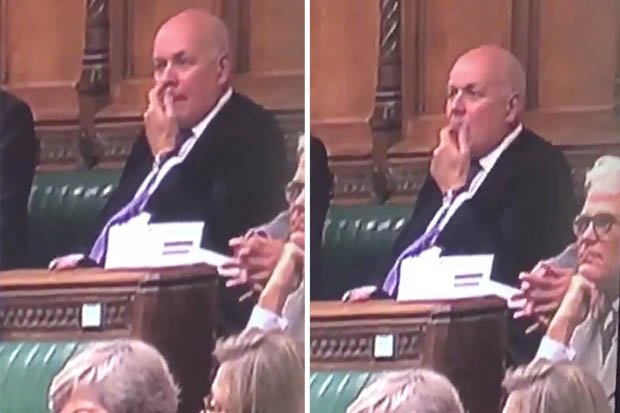
I doubt that he understands food poverty quite so much as your average man or woman on the Clapham Omnibus, if he or she can afford a ticket that is, but at a time when vast swaths of the country are suffering significant cuts to their living standards, I’d like to think he had some vague idea.
In the DWP where I used to work, staff, many of whom earn significantly below the national average wage, had a 2% pay rise this year, except that whilst their wages were increased by 2%, inflation more than ate into it. Let’s look at the evidence:
- Overall food inflation: 13.3%
- Fresh food: 15%
- Pasta and tinned food: 11%
Today, Brand Rishi Sunak unveils his masterplan whereby everyone up to age 18 will learn Maths, despite falling numbers of teachers and cuts to the education budget. I am completely hopeless at Maths, but even a quarterwit like me can understand that if your wages go up 2% but your food is going up by 13.3%, you are going to be worse off. In the DWP where I used to work (that line again) there are food banks and breakfast clubs for staff who claim the same in-work benefits as they pay out. I suppose under Sunak’s so-called plan, at least people will be able to work out with greater accuracy just how much worse off they will be. I am thinking that for a man worth three-quarters of a billion quid, food inflation will not be troubling him greatly.
At different times of my working and now voluntary working life, I have seen poverty. In the 1960s and early 1970s, I grew up in it. From 1974, I went to work for the DWP where I stayed for nearly 40 years. I used to see pockets of poverty, usually confined to particular areas. It’s not just pockets now. And one big difference is that poverty is now common among people in work. That, I contend, is a consequence of 12 long years of Conservative austerity, where millions of people have seen their standard of living fall to an extent now where many cannot eat or heat. People used to doubt that poverty really existed in modern Britain. I am here to tell you now that it does and it exists in places where you would not dream it could.
In 2017, the multimillionaire MP for the Victorian age, Jacob Rees-Mogg, said he felt the support given to food banks was “rather uplifting” and it “shows what a compassionate country we are“. I’d say Rees-Mogg was gaslighting the nation because while I am constantly in awe of those kind people who donate so generously to food banks the words he uses are twisted and misleading. It is an example of how I always define the very meaning of charity. Charity exists to pay for things we do not deem important enough to pay for collectively through society. Now, you can say that people acting individually, as I myself do by making a weekly donation to a food bank and volunteer for one, but I would always argue that collectively we achieve so much more than we do as individuals. If we are relying solely on the generosity of the individual, then many aspects of society, if it exists, are built on sand. It doesn’t need to be this way.
Some people, I know, don’t believe poverty in the UK is a thing. And if the Mail and the Sun says it’s not a thing and instead those suffering poverty are merely skivers and scroungers – as they frequently do – then we are fighting an uphill battle to convince people poverty is real and increasingly is felt by people who work and it’s not just the sick and disabled who are suffering. If you don’t believe me, come with me and I’ll show you something to make you change your mind
