
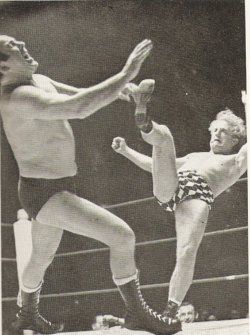
One thing I really miss these days is good old fashioned professional wrestling. I grew to love the ‘sport’ as a young child, sitting with my grandad every Saturday afternoon, watching the superstars of the day, like Mick McManus, Jackie ‘Mr TV’ Pallo and the great Kendo Nagasaki. And of course it was a sport in those days, the late 1960s onwards, because it appeared in ITV’s World Of Sport. You wouldn’t have something on World Of Sport that wasn’t actually a sport, would you? Besides, the presenter Dickie Davies was entirely serious as he introduced the wrestling and the commentator Kent Walton called it as if it as a boxing match, referring to the actual weight of the wrestlers, the various titles (World Heavyweight Champion, European Middleweight Champio) and so on. And besides, my grandad never doubted a thing. This was a sport, end of. So I suspended my sense of disbelief.
World Of Sport would follow a distinct pattern. Three matches, often starting with a ‘shoot’ between two blue eyes who would shake hands after every move and ending with a couple of blue eyes v heels. These matches, recorded in advance at places like Batley Town Hall, were an essential part of our viewing. It was, in the age of three TV channels, that or nothing. We went for that.
Newspapers, like the News Of The World, would do exposés on how wrestling was fixed, using secret microphones and later the legendary villain Jackie Pallo wrote a book called ‘You Grunt, I’ll Groan’, confirming that nothing was real. But we still watched, we still believed, or at least my grandad did. I exercised my right as a young boy to pretend it was real, a bit like Santa Claus. In 1988, ITV cancelled the wrestling and British wrestling, played out in big venues, even the Royal Albert Hall and Wembley Arena, not to mention Bristol’s Colston Hall, essentially faded and died.
I then became interested in American Wrestling, which made little attempt to pretend it was a real sport, without actually saying it wasn’t a real sport. I grew to love the World Wrestling Federation (WWF) and, even more so, World Championship Wrestling (WCW), which were in major competition with each other. We even saw two live events, in Cardiff and Birmingham. WCW live, with Ric Flair, Sting (not the singer, by the way) and Steve who later became William Regal. When WCW went to the wall, WWF abandoned any pretence that wrestling was real, rebranding itself as World Wrestling Entertainment (WWE). Now you knew what you were watching was entirely scripted, results predetermined; basically an athletic acting performance. Just like it always was and secretly everyone, except my grandad, knew it was.
Did modern day wrestling suffer now that it was revealed to be nothing more than entertainment? On the contrary. It blossomed and grew. Attendances and viewing figures grew and it attracted younger fans. I was a rarity when I followed the wrestling, as you can see on videos from the 1960s and 1970s because, all over the world, the core audience was basically old. Look at today’s big TV shows and the audience is much younger and, I would say in contrast to the old days, more affluent and middle class. Old style wrestling was for the working classes, so much so that the wrestlers looked like the fans, bald and beer-bellied and so on.
I have no interest in wrestling these days, other than the old clips to be found on YouTube. I can view numerous matches from back in the day, some of which I watched with my grandad. And to be honest, that will do for me.
Wrestling bears little resemblance to the ‘sport’ I watched as a child, but then most sports don’t. Watch old clips of football, rugby and cricket matches and you note straight away that the players are younger and more athletic. That doesn’t mean the old players weren’t any good but sports science has. Wrestlers are generally heavily muscled giants, with bodies created through gym work or they’re chemically assisted.
I suppose what I really miss is being very young spending Saturdays at my grandparents’ house, a house that didn’t have a bathroom and only had an outside toilet (which never felt unusual to me). A bag of chips for lunch, pikelets cooked over a coal fire for tea and the wrestling.
But now the wrestling has gone, as have my grandparents (and parents, for that matter) and life moves on until mine stops, too. I loved the wrestling. It gave me huge amounts of pleasure, although it used to drive grandad mad when the heel inevitably won, as we always knew he would. And always, at the end of the show, Kent Walton would say, “Have a good week till next week.” He always kept that promise and, probably very sadly, it was my weekly highlight, made even better if grandma had an extra pikelet, which was as pleasurable as it was rare. The good old days weren’t really that good because grandad and grandma lived in virtual poverty but viewed through rose-coloured glasses they were the best.
