
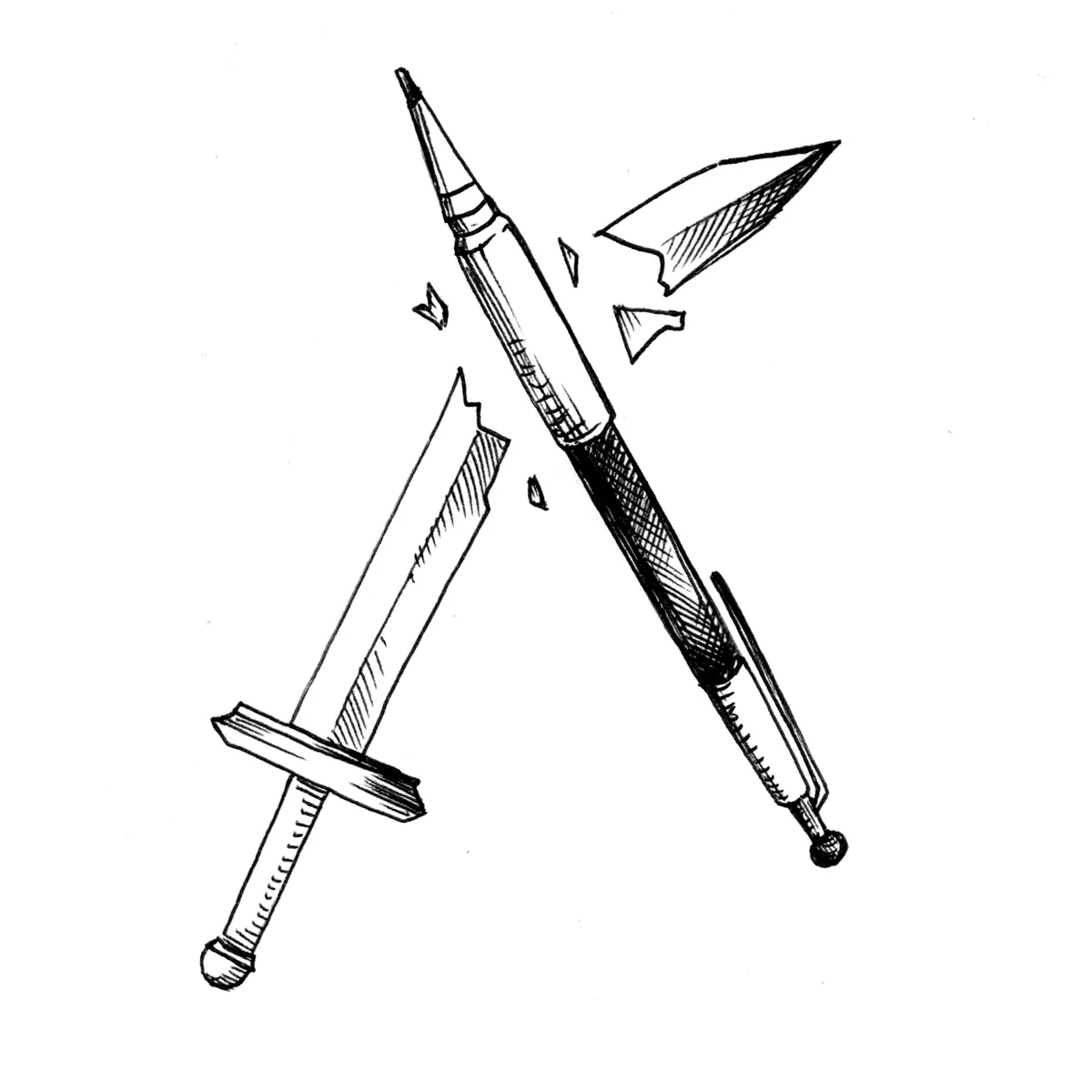
You will doubtless be familiar with the expression ‘the pen is mightier than the sword.’ According to Google AI (so it must be true) ‘it was coined in 1839 by English novelist Edward Bulwer-Lytton for his play Cardinal Richelieu, where the character realises he can rule without violence.’ As someone whose writing is marginally more effective than my swordsmanship skills, it obviously resonates with me. But I prefer the updated version by the late comedian Marty Feldman where he pointed out that ‘the pen is mightier than the sword, and considerably easier to write with.’ Clearly, in a one-off situation, say a duel, a sword might be a more appropriate weapon than a pen but I’ll stick with the latter, at least for now.
My lifelong love of words has become more like an obsession. In a most childlike way, I am still excited, exhilarated even, when I find myself using a word I have never used before. When the mood is right, a word I have heard but never written comes seemingly from nowhere and when it does, I feel like adding in brackets, ‘I have never written that word before’. I don’t, of course, because for one thing, why would anyone care? But that’s what a deep love of words has done to and for me. Words matter but not always in a good way. And that’s what I am writing about today.
I am, beneath my gruff and unshaven exterior, a sensitive soul. Piers Morgan might describe me as a ‘snowflake’ because part of his shtick is performative cruelty from a position of wealth and power and maybe he, with people like him, would be right. Using the right words at the right time can make someone feel great, good or just better. When people have said nice things to me, I have remembered them, even if I don’t do praise at all well. But when people have said less than kind things, even if they have only been said out of thoughtlessness and clumsiness, they have stuck even more so.
I was at Junior School when a teacher said I had ‘a butterfly mind’. I would have been around nine or ten years old at the time but I can remember the moment like it was just now. And for someone who has virtually no memories of childhood, that is significant. The teacher meant I couldn’t concentrate, possessing a mind where thoughts changed constantly, flitting from place to place, in a heartbeat. I took it for what it was – an affectionate remark: it was certainly said with a gentle smile – but it also defined my whole life. And that was because it was true. It was just that ADHD was not a thing in the 1960s. I just had a butterfly mind. It’s very much a love/hate feeling these days.
Later, at the same school, another teacher was highly critical of the standard of my writing. He called me ‘spider writer’, explaining that my writing looked like a spider had crawled into an ink pot and walked across the pages of my exercise books. I knew straightaway this was in no way affectionate nor kind. It was criticism of my writing, understandable criticism, too, since much of it was unintelligible to everyone except me – and not always to me. If I hadn’t been so innocent, I might have blamed actual teachers for teaching me to write in ‘print’ style, with block lettering but then essentially telling me to write faster, in a cursive – joined-up – style. Mine turned out to be a ghastly hybrid of the two and it still is today. I was, and remain, extremely conscious about my spider-writing. Words, I learned very early, matter and both good and bad they stick around, often forever.
I wince at some of the things I have said and done over the years and dread and regret any effects the things I said might have had on others. Calling people by their cruel nicknames or by pointing out things that they would rather not have liked to have pointed out. I hope I have learned lessons, although I am certain I am a million miles from perfection. Everyone is. These days, I cringe when I hear clumsy and thoughtless comments from others and I still find myself affected by comments I can’t believe people actually come up with.
A friend had it casually pointed out to him that male pattern baldness was setting in and I could see it really hurt him. I had the same thing pointed out a very long time ago and while I rather wish being follically challenged wasn’t an inevitable fact of life in my case, there were other aspects of my physical appearance that bother me more. I’ll give you a couple of examples of how they were pointed-out to me when I hardly needed them pointing out.
I was among many folk who piled on the pounds during the Covid lockdown, not least because of government enforced rules saying we had to stay in and not go out. Ever since, it has been a constant struggle to get fitter and healthier. Frankly, I did not need reminding that I had piled on the timber. But being reminded of it was precisely what happened.
I attended a social function in a nearby suburb of South Gloucestershire and was greeted by an old acquaintance who immediately pointed out my weight gain. “Thanks for pointing that out,” I responded. “You’ve really made me feel saying that in public. Thanks again.” Did that have the desired effect? Not a bit of it. On both subsequent brief meetings, I got the same comment. Even my drippingly sarcastic ‘thanks for pointing it out” response went in one ear and out the other. Perhaps, you might argue, the truth hurts, but I believe it’s my truth, not his. I thought afterwards, what if I had asked him how his daughter was: “Is she still morbidly obese?” But I would never, ever say that. I only thought of it as a ‘what if?’ scenario. I’d like to think that, at least today, I am better than that. But still it went on, with people I know – never, it should be added, close friends – who would point out what I already knew.
What makes people behave like that? Is there a bit of sneering superiority at work, people trying to make themselves better than you? If I think hard about cruel things I could ask people, it’s not hard. But I see no mileage to be gained from being cruel, or even mildly unkind. I won’t forget the words, though, whether they came 50/60 years ago from teachers or months ago from people who I would have hoped were better than that. The only solution is to ignore them forever.
Now the pounds are tumbling off, it’s been strange how no one has mentioned it. Not, I hasten to add, that I want people to because frankly it’s none of their business, but it seems to be far easier to point out the negative stuff, the warts and all, regardless of how crass it makes someone sound.
The pen is indeed mightier than the sword in most of the ways that matter, unless you are setting about killing someone and as a responsible blogger I’d urge you not to do that. But what I would say is this: don’t be a cunt all your life. It’s much easier to be nice to someone than it is to ridicule and insult them. Some folk may not be bothered about cheap insults about their appearances but some of us would rather not be reminded about them by people whose empathy for their fellow human beings seem to have left them
Many years ago, an old friend now departed was asked whether he had lost a lot of weight because he looked gaunt. He replied: “Yes, I’ve got terminal cancer.” He didn’t – and it wasn’t cancer that eventually got him – but the expression on the person’s face after he heard the reply was priceless. “I’m so sorry …” before my friend started laughing. That in itself was a harsh, maybe even cruel, response which I would never repeat but that was the power of words at work. Why ask questions like that? Be kind.
