
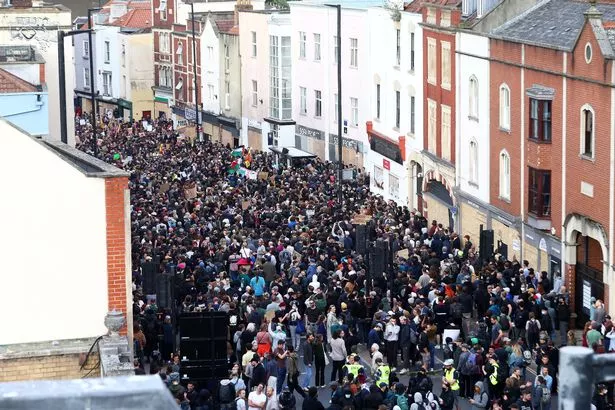
They think it’s all over … it is now. That, at least, appears to be the collective conclusion of our national newspapers, following a night where thousands of people gathered to, as the Daily Mail of all newspapers, “face down feared far right rioters”. That, incidentally, will be the same Daily Mail that has spend years fomenting hate and fanning the flames of disorder but I suppose we are grateful for small and large mercies.
I don’t know if “it’s” all over once and for all. The same leaders of the illiberal elite are still in place, albeit Stephen Yaxley-Lennon has crawled under a metaphorical rock and chief hate preacher Nigel Farage, a man who has done more to damage and divide Britain then anyone else in modern history (possibly), is now presenting himself as some kind of defender of law and order. Meanwhile, the people who were encouraged to attack desperate refugees, trying to burn people to death in hotels hired by the previous right wing home secretary, are either beginning lengthy jail sentences or fearing that 6.00 am knock on the door. And the issue of migration still hangs heavy in the air.
So, maybe peace for now, hopefully in Bristol where many thousands of people gathered to see off the angry mob who ultimately failed to show up. I was proud of my city, just a few days after I was deeply ashamed of it. But, as the Osmonds so memorably put it, “One bad apple don’t spoil the whole bunch, girl”. (This reminds me to pick up a bunch of apples later on when I visit Sainsbury’s, maybe along with a bag of bananas.)
What won’t go away is the issue of migration itself and it is important that the government get a handle on it. We know that many people are concerned at the levels of migration. In the last set of figures, which was in 2023, 1.2 million people migrated into the UK and 532,000 people emigrated from it, leaving a net migration figure of 685,000. The concern of many is where will these people live, whether there are sufficient school places, which benefits will they be claiming and how will it affect our “culture”. Then there are the small boats coming across the channel, a completely different kind of migrant, coming to Britain out of the fear of persecution and not for economic reasons. One of the big issues is that the different types of migration become conflated.
The thoughts and fears over migration are shared by many. I’ve already expressed some of the fears. People coming over to steal our jobs while simultaneously living the life of Riley on benefits, muslims opening a mosque on every street corner; that kind of thing. And one group of people feel they have not been part of the debate: the public. During 14 years of Conservative chaos and incompetence, they have a point.
Of course, Brexit changed everything. The freedom of movement we used to enjoy has now gone and workers from EU countries are less likely to come here. They have been more than replaced by people from the likes of India, Nigeria, Pakistan and China to the tune of nearly 700,000 people last year. And it’s important to emphasise that the near 700,000 net migration figure refers solely to legal migration, where people have applied to live here.
Speaking personally, I don’t particularly care who comes to live in our country. How could I since 5/8ths of me is foreign and only 17% of my DNA is English? But even I have concerns about the assimilation of people into the UK. I am a card-carrying secularist which is to say that I believe in equal treatment and freedom of belief for all. And because I feel the issue is so important, I shall set out the three main pillars of secularism, lifted from the National Secular Society (of which I am a member) website:
- Equality so that our religious beliefs or lack of them doesn’t put any of us at an advantage or a disadvantage.
- Freedom to practise one’s religion or belief without harming others, or to change it or not have one, according to one’s own conscience.
- Separation of religious institutions from state institutions and a public sphere where religion may participate, but not dominate.
This looks awfully bland at first glance, so what does it mean? Well, it means that no one of any religion or of none is at any advantage or disadvantage. You gain no privileges from being, say, a theist or as an atheist. We are all the same under one law. People can practise their own religion but they cannot use it to affect or harm others. The state must be separated from all religious institutions. Simple? Yes it is, actually.
We all live under one law of the land and there are no special privileges for those of religion (so no religious schools of any kind and no religious animal killing rituals).
I have long had concerns about the term multiculturalism, which I find it hard to express. I celebrate diversity and do not expect or want everyone to be the same. A multiethnic, multiracial, multi-faith society holds no fears for me. But what about the culture of honour killings, of female genital mutilation, of cruel methods of animal slaughter? Secularism addresses all these issues and it’s high time we had a chat about it.
Meanwhile, the shutters in Bristol’s Old Market area have come down and life returns to normal, at least for now. But the tinderbox of issues that brought about the riots has not been destroyed. The legitimate concerns about migration and the less than legitimate lies on social media are still there. There are concerns about the integration of certain groups like the muslim community. We cannot build back better unless we address people’s concerns, even if we think, in our hearts, they are wrong or that the fears are exaggerated.
Many people voted for the disaster that is Brexit feeling that they had been ignored and forgotten, in some instances with good reason. And although the so called solution was Brexit, which would make things even worse, many of us have buried our heads in the sand and pretended that it occurred just because millions of people were misguided and wrong.
The country has left millions behind. There were 35 food banks in the UK in 2010 and now there are around 2800. Millions are in low paid insecure work. Young people are finding it increasingly difficult to get on the housing ladder. The gap between rich and poor has never been wider. All these things and more cause disillusionment and a widespread feeling by people that the government is not on their side, leading to fears, imagined or not, that Johnny Foreigner is getting all the goodies when they are getting none.
I am neither clever nor influential enough to bring about change to our country that can only come about if we have an open and honest debate in which everyone can participate. Britain tends to deal in top down solutions and we should know by now that never works.
Are the riots over now? I don’t know, but I hope so. We have a chance now to act, to listen to and address people’s concerns and fears, whether real or imagined. If we don’t, then sooner or later things will kick off again, as they always seem to.
