
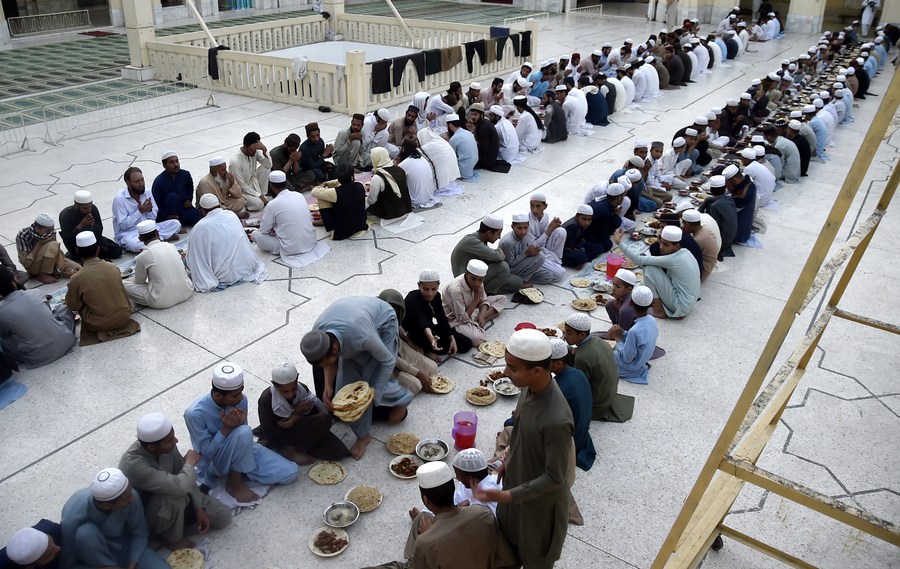
For me, Ramadan is a special time of year. Only yesterday, I was sitting outside my local pub just after 6.25 pm, waiting for sunset. Only then could I break my fast and sink a well-deserved pint of Estrella Galicia. I can tell you, that first one barely touched the sides. “Allahu Akbar!” I announced to the bartender. “Another Estrella, please.” Of course, none of that really happened because, although I am a secularist and support the rights of anyone to believe in the God of their choice no matter how ridiculous it might be, the holier-than-thou – literally – really do piss me off.
I was uninspired to write this blog having read what we experts call a load of old tosh in today’s Observer. In this article by the Australian muslim and journalist Shadi Khan Saif, she refers to “the challenging yet cherished daytime discipline of refraining from food and water, the experience within a multicultural landscape is particularly fascinating. In a society often fixated on material pursuits and instant gratification, fasting provides a sense of contentment that cannot be found in worldly possessions.”
I don’t see anything remotely “fascinating” about refraining from food and water, as part of a superstitious religious ritual. And not all of us are “fixated on material pursuits and instant gratification“, either. But then the sneering superiority of the devout creeps in again: “As I walk past restaurants and the aromatic coffee shops of Melbourne, the inner struggle to resist temptation serves as a vivid reminder of what hunger and thirst must feel like to millions of people.” “The inner struggle” to eat something and have a cup of coffee? Oddly enough, as an atheist I have no “inner struggle” as I walk past Costa, desperately fighting the temptation to have a Latte.
The entire article is one of high end gobbledegook. “The overarching sense of being in a state of meditation lingers throughout the entire month,” warbles Saif. “This immersion in a soul-cleansing process helps instil the lovely values of truthfulness, kindness and charity that endure long after Ramadan has ended.” But I think this is the best bit: “Ramadan is not merely about abstaining from food and water; it is also a time to refrain from even the smallest acts of selfishness, impatience or dishonesty in all areas of life.” Well, speak for yourself, love. I don’t actually need to abstain from food and water or anything in order to “refrain from even the smallest acts of selfishness, impatience or dishonesty in all areas of life.” Why, pray, do you?
To me, Saif’s self-absorbed article is typical of not followers of her religion, but those of all religions. Just who are these fanatics trying to impress? When I donate to a charity and indeed volunteer for one, I don’t think to myself, “Well, I hope God is watching because he should be very impressed and hopefully he will reward me with a place in Heaven when I shuffle off my mortal coil.” In the unlikely event you’re there, God, I do good things because I want to do good things. It’s in my nature, not my superstition.
All this Ramadan malarkey comes from the Qu’ran, which in common with all other religious texts is a book of fiction, compiled in times when no one knew what was going on and the only science was superstition.
The article concludes with more gobbledegook. “Ramadan offers a chance to rid oneself of negative traits and focus on inner growth.” Yeah, not eating or drinking during daylight hours would definitely do that, wouldn’t it? It’s definitely not something you could do any other time of the year. is it?
By all means, have your Ramadan. I think it’s ridiculous, but each to their own, I say again, as long as it does not affect my own life in any way. I’ll even raise a glass to you and I won’t take the piss by waving it in front of you while you’re fasting. Even I can show respect sometimes.
