
My MP, when I lived in east Bristol, was Tony Benn. If you wanted to piss him off, as many did, you referred to him by his real name of Anthony Wedgwood Benn, which sounds awfully posh for a hard left champion of the workers. But then, he also went to one of the most elite schools, Westminster, followed inevitably by Oxford University. A working class hero is something to be and despite his weird and romantic fascination he had with the ‘working class struggle’, it was something he had no real clue about.
I joined the Labour Party in the mid 1970s when Benn was ensconced as the MP for Bristol South East. The Constituency was controlled by a Trotskyist sect called Militant tendency and if you wanted to get on in the party you needed to be a member – sorry, paid supporter – of Militant. (Actually, the right word was member, but of course Militant pretended it was merely a group within Labour. Even the innocent and naive me knew that was a load of old tosh.)
What I noticed over the years was the process Benn was going through as he moved from a left wing figure to a far left figure. To his credit, he visited the constituency most weekends, arriving on a Friday evening where he would meet local activists and sometimes he would hold a public meeting. On Saturday morning, he would hold a surgery for constituents before returning to leafy Holland Park in London, where he always lived. While Militant were doing their level best to recruit me and my best friend Nick to their cause, we were obviously on the outside looking in. Benn was a charismatic figure and a brilliant public speaker and while I liked a lot of what he had to say about the country, essentially abandoning capitalism and embracing pure socialism, I felt there was little depth to his words, just pipedreams and slogans, essentially a simplistic outlook on politics.
In 1975, while being on the left of politics, Benn thought nothing about campaigning against the Common Market, now known as the European Union, with the hard right MP Enoch Powell, who by then had left the Conservative party and now sat as an MP for the Ulster Unionist Party. In fact, Benn didn’t just campaign with Powell: he liked and admired him greatly, happily sharing platforms up and down the country, urging voters to reject Europe in the referendum that took place. It was the equivalent of Jeremy Corbyn today sharing a platform with Nigel Farage. Far left and far right together, the political horseshoe effect in action. Following the referendum, which saw us join the Common Market, the Benn/Powell love-in fizzled out and Benn became the de facto leader of the hard left in Britain.
After Labour lost the 1979 General Election, Benn’s lurch to the left accelerated, something that was mirrored across the Labour Party and the trade union movement, not least after the new Tory MP Margaret Thatcher set about the destruction of British manufacturing and the castration of its trade unions. In the 1983 election, Labour was led by ageing Michael Foot from the hard left, a die hard socialist of the old school. Thanks to Benn, Labour went to the country with a manifesto so left wing, one MP, Gerald Kaufman, described it as, “the longest suicide note in history.” Leave NATO, leave Europe, nationalise everything, unilateral nuclear disarmament, increase migration, stronger powers for trade unions and so on. It did not go down well with voters, who re-elected Thatcher who returned to Number Ten with a landslide majority. Worse than that for Benn, his constituency had changed to Bristol East, taking in more middle class areas. He lost his seat.
While Benn sought a new parliamentary seat – he found one in Chesterfield – I stayed in Bristol East, at least for seven more years. My own politics had stayed almost the same. I started off a soggy, liberal (with a small l) left of centre Labour man and that was what I remained. More than that, I felt I was right.
Labour kept losing. Whatever the rights and wrongs of the far left – and most people could agree with some of the things they stood for – most people wouldn’t vote for them. When The Great British Public was offered full fat Bennery, they gagged, then re-elected the polar opposite of Bennery: the me first, I can have everything now, there is no such thing as society Thatcherism. As a young man, I knew I had some kind of antenna that led me to the place where Labour could win from. The only place Labour could win from, which was left of centre where I had always been.
Benn immatured with age, not just having a real dalliance with unelectability but fully embracing it. The hard left didn’t realise that they would never win and, as became clear with the disastrous years of Corbyn, they didn’t particularly want to. For them, it was about building a political movement, not a government.
Then, Neil Kinnock came along, leading Labour to two more defeats in 1987 and 1992. It wasn’t that he was no good. In fact, he was very good but the media went after him, creating the image of the Welsh windbag by way of a relentless negative attack. He had almost made Labour electable, but not quite.
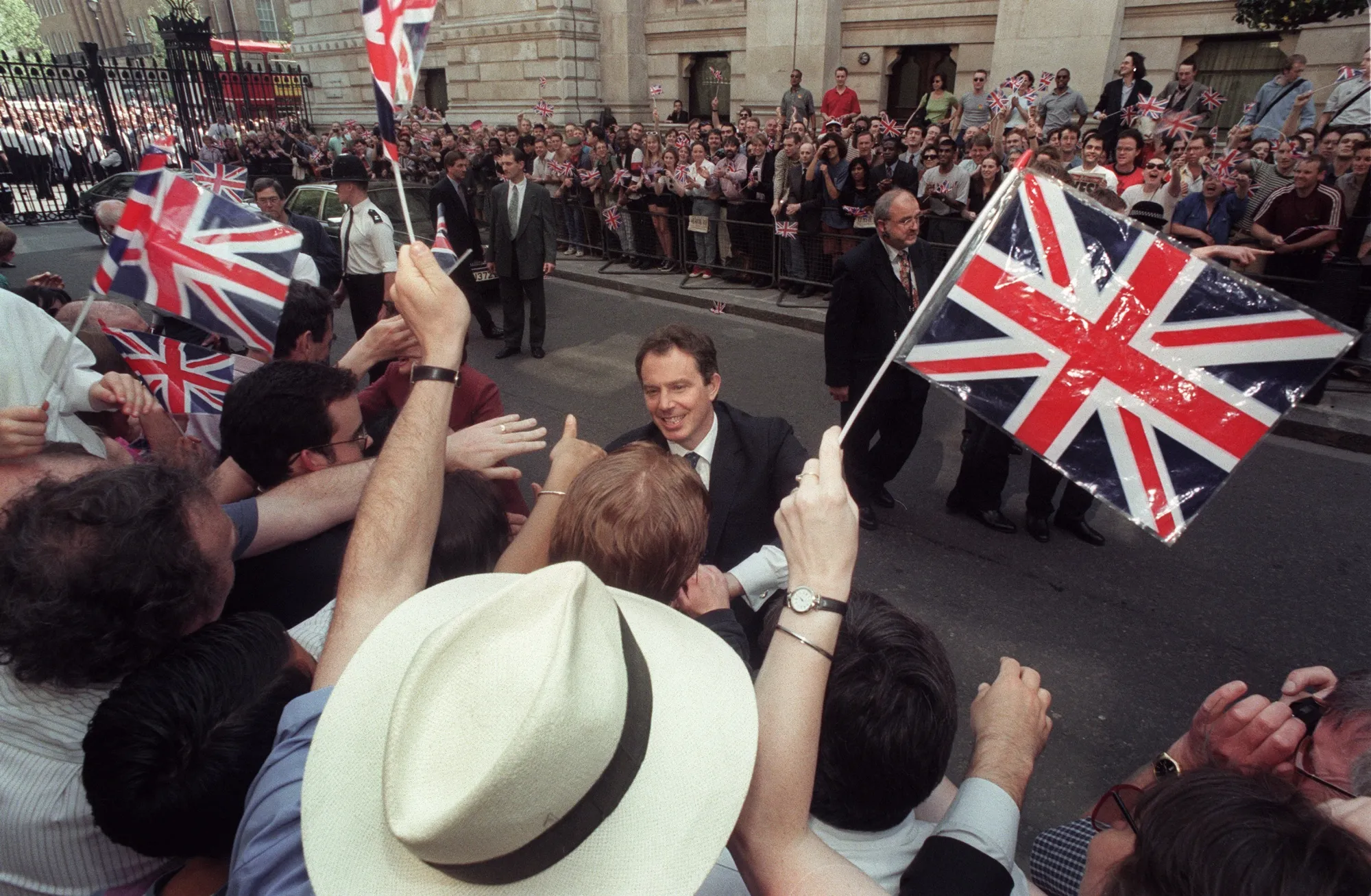
Long before he was even heard of, I was a Blairite. I believed with all my soul that Labour could only come at the public from the left of centre, and sometimes in the centre, if it was to win. Not only that, it needed someone who actually believed in every word of what he said because people vote on the basis of trust. So, Blair meant what he said, he was a brilliant communicator and more than that, a brilliant political operator. When he won in 1997, 2001 and 2005, I felt vindicated.
Tony Blair changed the country for the better. Generally speaking, Britain was more united than it had been for decades. We were better off, poverty went down, the NHS improved dramatically, as did schools. By almost every metric, things got better. Hard line socialism it wasn’t but for me, that’s not what I ever wanted. A better, more equal country, a meritocracy even – that’s what I believed in. And to a large extent, I got it.
In old age, Tony Benn became a national treasure, not least to the establishment who had previously hated him but realised that his politics was actually an asset to them. Even more harmless in retirement, he was feted and cheered by all his one time enemies. I came from another angle. Benn’s political tomfoolery had only succeeded in prolonging poverty and division. His fine words were rhetoric and slogans, his ideas were simplistic. Arguably, his one big success was Concorde, a hugely expensive aircraft which turned out to be the exclusive preserve of the upper classes, paid for and built by everyone else, but mainly those who would never fly in her.
I still believe in the Blairite type politics today and only wish the great man was still in high office. I’ll stick with Keir Starmer, though, who is leading the Labour government against a vicious and full-on media war by the media, from the usual suspects like the Mail, Sun, Times, Telegraph etc, but also Sky News and the Reform friendly BBC. I have never seen a vicious campaign like it and for now it’s working, with the suggestion from the polls that in the next General Election Britain could elect a far right, even fascist government led by the Fagash Fuhrer Nigel Farage.
I would like to think we would avoid extremes when it’s time to vote again. Sure, there are compromises to be made in order to elect a Labour government but that was how Blair won and how Starmer won in 2024.
I’ll repeat yet again what I always say about the Blair years. Britain was a far better place when Blair was PM and Gordon Brown was chancellor. They gave us more than a decade of continuous improvement until the worldwide financial crash came along in 2008. If you don’t remember that, you weren’t there.
We were told in 1997 that things could only get better and they did get a lot better. They always will under a Labour government that sits left of centre but embraces the middle ground. It’s a theory I have always maintained and today I believe in it more than ever. History, for once, is on my side in that sense. But then, in 2010, the electorate fancied a change and gave us 14 chaotic years of Tory government, leaving a complete mess for the incoming Labour government to clear up. Frankly, if we forget those 14 miserable years and go back to square one in 2029, those who vote for it will deserve everything they get. It will be a shame, though, if those of us who long for a kinder, gentler, more equal world, with strong public services, dignity for those in care and in old age and hope for the future are plunged back into the fear and loathing of the Tory party or worse still Farage’s private company, Reform UK Ltd.
As ever, it will be an easy choice for me because my views and values have hardly changed. I still believe in the same things. I reckon a lot of people share my instincts. Whether they vote for them is something else altogether.
