
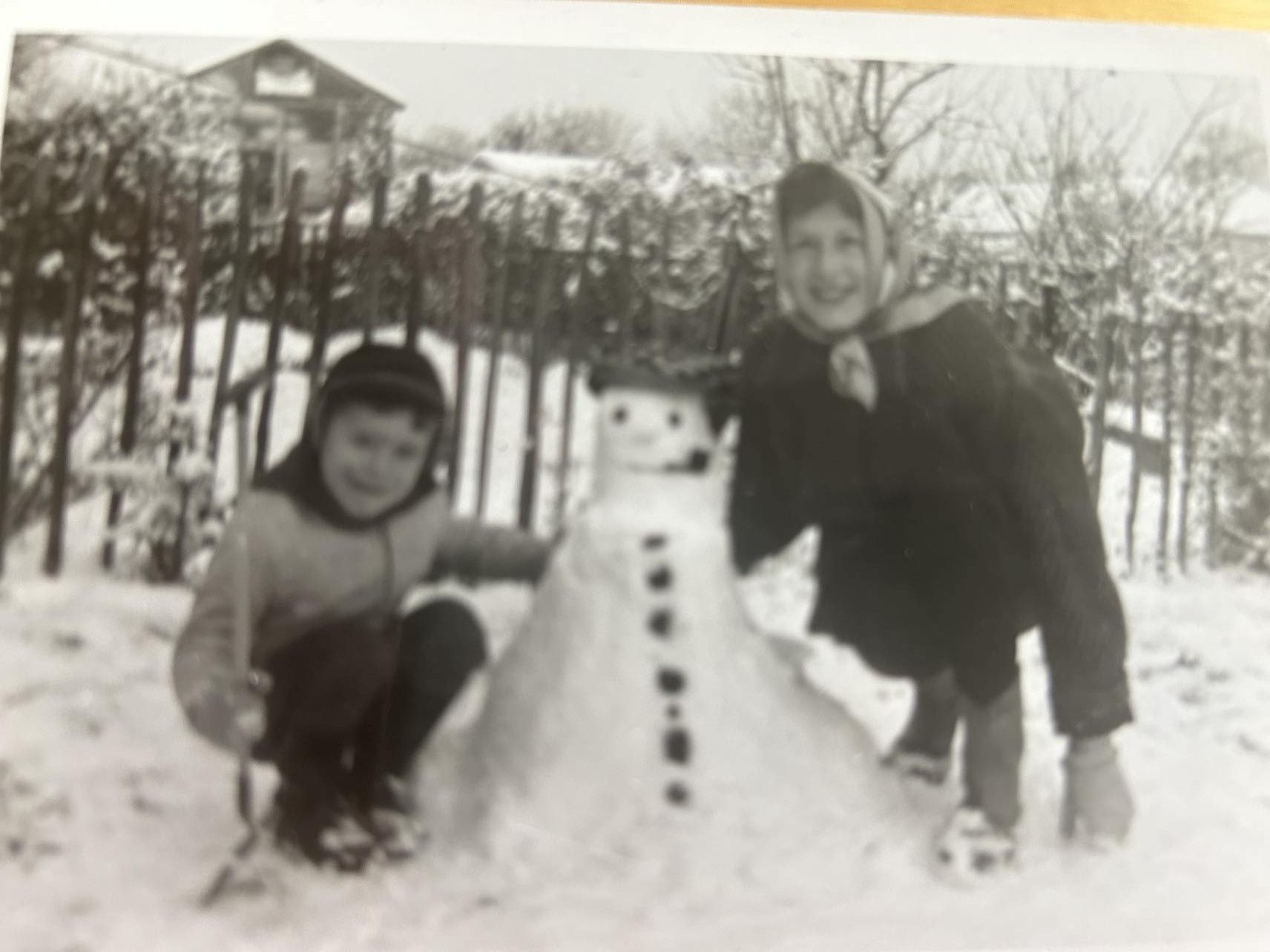
I don’t often take photographs of photographs, but today was the exception, at least to my eyes. Because today is my mother’s 100th birthday. Born Neeltje Verburg on 18th August 1923, daughter of Marinus and Anna Verburg of Rotterdam in the Netherlands. I say ‘is’ but ‘was’ a better word since she is far too dead to celebrate her big day. She shuffled off her mortal coil on 31st October 1999, having miraculously made it to the age of 76 despite a lifetime of heavy smoking. Smoking ruined the last twenty years of her life and it was horrible to be a close spectator of her decline. Although she made it to 76, she had no life at all. My abiding memory of my mum was her in terrible pain and distress and that’s why you won’t ever find gushing over how much I miss her because when her time came, it was a blessing.
The photo that heads this blog was taken during the frozen winter of 1963 in the back garden of our home on Warrington Road in Brislington – Briz, as Bristolians call it – in Bristol. I don’t remember it at all, as I remember next to nothing about my childhood, although I do know, because he told me, it was taken by my paternal grandfather Alfred Johansen. His pipe and cap can be seen on the snowman, which I believe stood for over two months as the country came to a complete standstill. It is, though, a happy photograph and one that makes me smile, something that I don’t manage to do when I think about her later life.
It’s one of a very few photos that exist from my childhood and there’s a very good reason for that: we didn’t own a camera. Therefore, just about every photo I have of my childhood and most of those featuring my mother were taken by Alfred. He was still using the same camera into the early 1970s when we holidayed in a tiny caravan at West Bay in Dorset, the only place I ever stayed in for a holiday, apart from spending the school holidays of each summer in Rotterdam with my mother and grandmother. We did literally nothing on those Dorset holidays, beyond walking around the harbour and sheltering from the incessant August rain. if I have few memories, it’s more likely there was nothing much to remember.
Neeltje, or Elly as she was known to all and sundry, was a stranger in a strange land. She came to the UK in the early 1950s to marry my father Anthony, a merchant navy officer and by the early 1960s was a lone parent after they separated. I have no recollection of them ever being together and I know now I missed out by never having a father figure in my life. Elly did her best, but with no real idea of how things worked in the UK and no social group to fall back on, I left school with scant qualifications, worked in a dead end job, not knowing what to do in my life (I still don’t) and left to deal with my mental health issues on my own. I don’t blame anyone: that’s just how it was back then. But we are all, in some way, the product of our upbringing.
Elly worked in the ladies’ fashion houses of Bristol, names like Hammonds and Whitbys. We lived in a large, terraced house in Briz which was next to impossible to keep warm in winter. We had one electric fire we carried around the house if we went into another room and a coal fire in the living room. I never went hungry, but that was only because, I later realised, Elly did. After work, she would wait outside Josef Packaert’s butcher shop on Nelson Street and pick up whatever scrag ends of meat she could get, often for pennies, sometimes for nothing at all. It never, once, seemed odd to me that while I was eating my tea off a wooden board in the living room, while watching our tiny fizzing and crackling black and white TV, she was eating nothing at all. Years later, I felt almost inconsolable guilt at what had been happening, although I later understood it wasn’t my fault.
In the late 1970s, she met and married George Drury, an old friend of my father from sea-faring days, living in a detached bungalow overlooking the Bristol Channel in Portishead. She left the house in Briz to me, mortgage free (more about that later). It all seemed like bliss, the happiness she deserved, even though she did not appear to yearn for it. They went away to Cornwall on holidays, she made friends for the first time since she left the Netherlands and George was a steady, kind and gentle man who loved and cared for her. What could possibly go wrong?
I visited every week and I watched Elly’s health decline rapidly. Smoking affected her heart and caused blockages in her legs, topped off by terrible pain. George developed Parkinson’s and eventually they were moved into residential care.
In October 1999, we were on holiday with our young children. This was long before the advent of mobile phones and we were unaware that anything was wrong until we got home to find the telephone answering machine bulging with messages from the proprietor of the care home. I knew what was coming and sure enough the news when I rang was that she had died from a massive heart attack.
Some weeks later, I organised the funeral at South Bristol Crematorium. Hardly anyone came because Elly had no friends left from Bristol and most of the ones she made in Portishead had died, too. There were probably eight or nine of us. It was no celebration. I didn’t even take her ashes with me. I only cried once and that was when I phoned her brother, my only uncle, Jacobus ‘Koos’ Verburg who couldn’t have cared any less if he tried. I never cried again and I never spoke to him again.
George, widowed for the second time, suffered from Parkinson’s and then dementia. I still went to see him, the only person who did. And I was with him the moment he died. It was a blessing, as was Elly’s death. No more suffering.
I miss her from when she was healthy and happy but I do not miss the pain and agony of the later years. And that is why you will never see me wishing her a happy heavenly birthday because there is no heaven and even if there was I wouldn’t want to be associated with a God who allowed her to suffer the way she did.
Mum is 100 years old today, but she isn’t really. I am grateful for the life and love she gave me and for the personal sacrifice she made to ensure I didn’t go hungry. And she always did her best. You can’t really ask for more than that.
Footnote: the house she gave to me was stolen by a former partner, whose violence towards me left me in fear of my life and I had to leave. I’m well over that, but I hope she isn’t. I only wish there was a hell for her to go to. Sorry to end on a sad and angry note, but you should have seen my mum’s face when it happened.
