
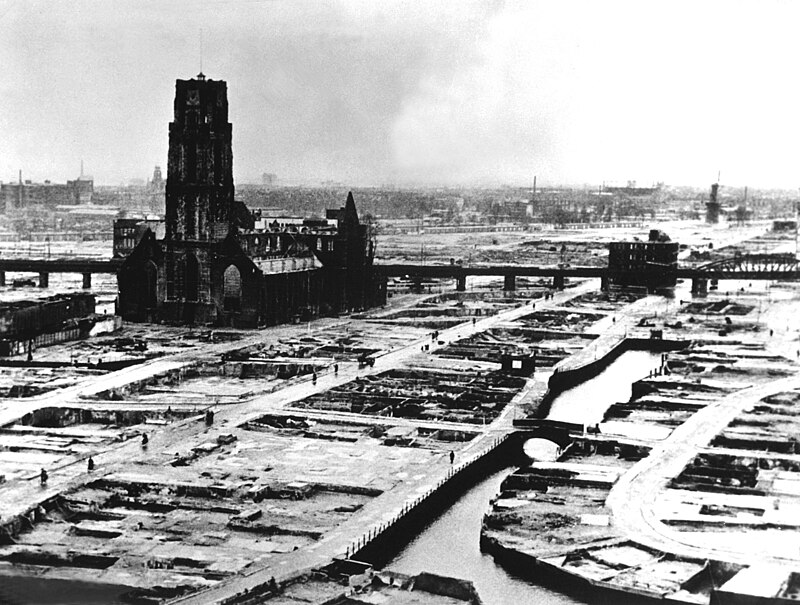
Everyone from my family who was around during the two world wars is long dead. My paternal grandfather, Marinus Verburg of Rotterdam, died before I was born and I know nothing about his experiences of war, if he ever had any beyond the destruction of his family’s apartment and all their belongings during the Luftwaffe bombing of 14th May 1940. My mother, then Neeltje Verburg, had a little to tell, seeing as she did the courageous Dutch marines fighting desperately to keep the occupier at bay. She saw soldiers die in combat, just a few yards down the road. In the years that followed, the family observed Dutch Jews being taken in large numbers to the Westerbork transit camp, before their final journey to the Nazi concentration camps, like Auschwitz. She believed that she was fortunate not to be among them.
As people were herded up and taken to the railway stations for transportation, Marinus was questioned, interrogated could be a better word, about his own ethnicity. Verburg, said the officers, was a Jewish name. Perhaps, he feared, the whole family would be removed to who knows where. At the time, being taken to Westerbork has more innocent connotations. As time went by, the family realised it was anything but innocent. It was genocide.
They survived the war in absolute poverty and they were the lucky ones. Once the Luftwaffe had finished their job, effectively on one day, the following years meant living under often brutal Nazi occupation. In the latter years of the war, my mother who was by now in her late teens ventured to the clubs and bars of occupied Rotterdam, where young German soldiers drank their evenings away. Neeltje, already canny and streetwise, noted that they were just young lads – the Nazis were elsewhere – and as they got to know them realised they didn’t really want to be away from home. She even acquired some food and supplies to take home to their tiny, cramped, unheated and sometimes unlit apartment. Marinus never asked where it came from or else, figured Neeltje, he might refuse it. Either way, it was better than trapping small birds on the verandah and eating them, raw.
Rotterdam was occupied for five long years until May 1945. My Dutch family had survived, but at huge cost. They were stick thin, all their possessions were lost in 1940, both my mother and her brother Jacobus, had seen their education cut short. To say the future was uncertain would be a major understatement.
Meanwhile, in Bristol Alfred and Nellie Johansen, and their son Anthony, watched the main action from a distance. Alfred, my grandfather, originally from Gjovic in Norway, became a version of ARP Warden Hodges from Dad’s Army, putting the street lights out at night and telling people to draw their curtains tight for fear of German bombers having a clearer view of the cities and towns they wanted to attack. Anthony, aged 15 in 1944, keen to serve, lied about his age and sailed on the North Atlantic Liberty Ships, bringing supplies from the USA to Britain, while dodging the U-boat infested waters. He died in 2011 and I wish I’d asked him more about what I see as his heroism, his service to our nation.
When Remembrance comes along every year, it feels personal. Anthony saw service at an age when I was as immature a 15 year old as I could have been. The only boats I had been on were the overnight ferries that took me and my mum from Harwich to Hoek van Holland every summer. My dad could easily have died at sea, my mum could have been killed in the bombing or even in a concentration camp. My mum, as I said, saw brave soldiers fight against impossible odds and she saw them die. When social media is filled with ‘Lest We Forget’, that’s who I think about. Even grandad Alfred trudging the black streets of Brislington telling people to “put those lights out”. People did what they had to do. My dad and I had a fractious relationship at times, but for his service on the Liberty Ships, he is a hero to me. I am not sure I could be that brave.
I rarely wear a poppy, mainly because I always lose it immediately and anyway I seem to wear clothes that would be ruined if I attached a poppy, Instead, I’ll make a financial donation to the Royal British Legion and leave it at that. I do so because I want to honour those who sacrificed everything and to support former armed forces personnel who still need our help. (Quite why they rely on a charity and not the state, I do not know, but that is for another day.)
“Lest we forget”, I am being told across social media. “At the going down of the sun and in the morning. We will remember them.” Exactly that. And in this time of Remembrance we should also think about how and why so many wars begin and where they take us. With the ascent of actual fascists, like Vladimir Putin in Russia, and the rise of the far right all over the world, now, incredibly, including America, maybe we have forgotten? Is yesterday’s Jew, today’s migrant? When we say Lest We Forget in some throwaway social media post, let’s make sure we don’t forget.
My generation is permanently in debt to those who we remember today, including in my own family. Remembrance for me is personal. For you, it can be whatever you want it to be.
We all know the fourth verse of Laurence Binyon’s For The Fallen. Here is the first verse:
With proud thanksgiving, a mother for her children,
England mourns for her dead across the sea.
Flesh of her flesh they were, spirit of her spirit,
Fallen in the cause of the free.
“Fallen in the cause of the free.” Remember that.
