
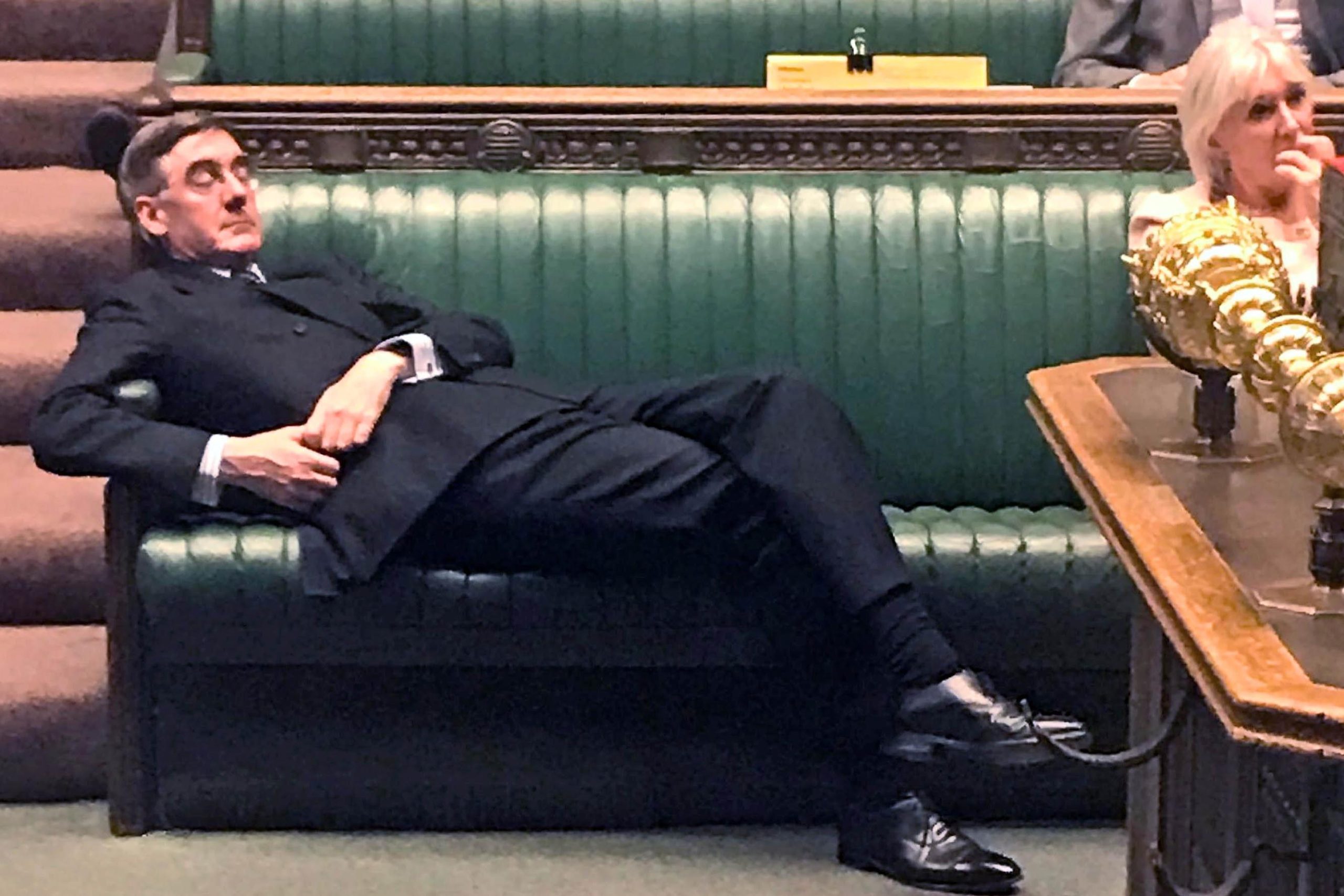
As I never tire of saying, charity exists in order to pay for the things society has deemed to be not important enough to fund collectively through taxes. So that’s the cost of researching cures for cancer, caring for former military personnel and being able to eat, these are all things that are okay to be left to the voluntary kindness of others. Well, that’s how Britain works today, following the gospel of the MP for the Victorian Age, the loathsome Jacob Rees-Mogg, who said, “Inevitably, the state can’t do everything, so I think that there is good within food banks.” Try and get your head round that for a moment.
Being Rees-Mogg – and who would want to be? – he digs deeper: “To have charitable support given by people voluntarily to support their fellow citizens I think is rather uplifting and shows what a good, compassionate country we are.” I have read this quote many times before but it never fails to raise my hackles. In 2010, when this awful Conservative government came to power, there were barely any food banks. It is specifically as a result of Rees-Mogg and his goons that millions of people are dependent on food banks. The only thing left now is for Rees-Mogg, a fanatical Roman Catholic, to lie through his teeth: “The real reason for the rise in numbers is that people know that they are there and Labour deliberately didn’t tell them.” In the unlikely event there is a God, then Rees-Mogg could be in a bit of trouble when he reaches the Pearly Gates. But before I get too hung up on my pet subject of food poverty, charity is now the norm, not the exception.
Like you, we are constantly asked to make a donation to one charity or other or to perhaps sponsor someone as they try to raise money for a much-loved cause. Financially speaking, our heads are above water at the moment and we do our best to support various charities, even if it’s just a couple of quid. But obviously we can’t support all the requests that come our way otherwise we’d be using charities ourselves. In our case, that will involve donating to charities which have minimal running costs rather than those with murky finances and take a large cut from each and every donation in order to pay its executives hefty six figure salaries like – oh, let me think – the British Red Cross. (This link isn’t actually the British offshoot, but it’s the same process at work.)
I don’t like saying no to charities because I understand the consequences of them not receiving donations. For example, what would happen to animals without the RSPCA, RSPB and the Cat Protection League? They’d all be euthanised. I’ll give them a few quid while I can. I am certainly not a fan of the old saying “charity begins at home” because if followed to the letter by everyone there would be no cancer research, even more homeless and suicidal veterans, innumerable dead animals and people dying of starvation. In fact, just imagine life with no charities at all. For many, life would not be worth living. But sometimes you have to say no. Here’s what we do.
This is not me trying to show what great people we are, but we make a weekly donation to the Trussell Trust which runs food banks. In addition, I volunteer at a local food bank every week. It’s no big deal; I do it because I enjoy helping people. If I didn’t, I wouldn’t do it. So there’s nothing grand about it, Many people do far, far more than I do. People say time is money, something I don’t necessarily agree with, but if it is, then just imagine I was paid the minimum wage for the time I work at the food bank. Put together with our donations, a back of a fag packet calculation suggests that we donate around £1800 to the Trussell Trust every year. I want no thanks for that because that’s not the point by giving time can be just as important as donating a few quid. In short, we’ve decided to concentrate our efforts on supporting something that means a lot to us. Neither of us came from wealthy backgrounds – far from it – and we know what it’s like to have nothing or next to nothing.
I write all this because I always feel a twinge of guilt when I am asked to donate to a charitable cause and refuse to do so. It’s not that the charity is any less worthy than others but there comes a time when you have to prioritise. Rees-Mogg, who is fabulously rich, thinks that supporting people who need food to be “uplifting” and “shows what a good compassionate country we are“, but I look at it another way. If we have many millions of people in food poverty, including four million children, I find that to be very depressing and shows just how bad people like Rees-Mogg actually are. You see, I just don’t understand how anyone can be as lacking in empathy as him. I appreciate he was born into wealth and privilege and has never experienced anything else, but Christ, mate, at least try. If you have ever met someone at a food bank who works full-time but doesn’t have enough money to feed herself in floods of tears then maybe, just maybe, you don’t have a heart at all.
I look forward to the day when our food bank manager comes up to me and says, “We don’t need you anymore. Food banks are a things of the past,” I’d be a happy man indeed.
I’ll never forgive the likes of Rees-Mogg for what they have done to our country, many parts of which are now an economic wasteland where nothing works and where people have no hope. Soon, we will gave a general election and if it appears likely that Jacob Rees-Mogg will lose his Bath an North East Somerset seat, I will be there at the count to rub his nose in it.
Charity may begin at home, but it shouldn’t end there. Of course, you look after your family first but in the end we’re all the same flesh and blood. And, I firmly believe, most of us are far better people than the likes of Rees-Mogg could ever be.
Charity, however we wish to define it, is essentially sticking plaster and no more. But if we don’t apply our own sticking plaster, the whole caboodle comes apart, if it hasn’t already.
PS First time I have ever used the word caboodle.
