
In 1971, there was an occasion called Glastonbury Fair which the following year was documented in a film called Glastonbury Fayre. It was a free festival and featured the likes of Hawkwind, Traffic, Melanie, David Bowie, Fairport Convention and Quintessence and some 12,000 people turned up to watch. 1971 was also the year of my first ever live gig when on 28th November 1971 we went to the Bristol Colston Hall to see an emerging singer songwriter. His name was Elton John.
We went to see him on the basis of his new LP Madman Across The Water which I thought then, and still think now, was a brilliant record, all killer, no filler. This was long before the days of the Elton John big band and he was accompanied by Dee Murray on bass and Nigel OIsson on drums. I cannot claim to have a vivid memory of the show, never mind the setlist, but according to various internet sites it went something like this:
Your song
I need you to turn to
Rock me when he’s gone
Tiny dancer
Rotten peaches
All the nasties
Skyline pigeon
Love song
Indian sunset
Ballad of a well known gun
Friends
The king must die
Can I put you on
Razor face
Honky tonk women
Holiday inn
Madman across the water
Take me to the pilot
My baby left me
Whole lotta shakin’
The same websites also say that Elton’s band included Davey Johnstone on guitar, but it certainly didn’t in Bristol that night. I would describe the show, to the best of my ability, as being very good. Nothing earth-shattering, but he had a lot of very good songs. I remember the support act, too, who were England Dan and John Ford Coley, a pair of yee-hawing, cowboy hat wearing Americans who went on to have a hit with this song.
On 21st June 1975, I saw Elton again, this time at Wembley Stadium as part of Midsummer Music where he topped a bill that also featured The Beach Boys, The Eagles, Joe Walsh, Rufus feat Chaka Khan and Bristol’s finest, Stackridge. It was a boiling hot day, we were miles from the stage, the sound quality wasn’t great and this was long before the days of big screens but we managed to enjoy the show right up until Elton appeared.
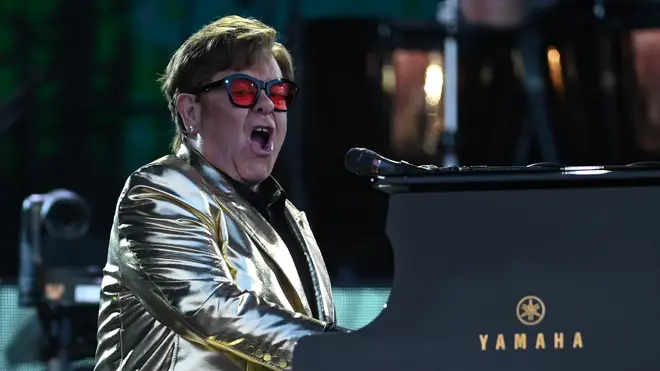
For some inexplicable reason, Elton decided to open his show with Funeral For A Friend/Love Lies Bleeding which is a medley of two songs in which the singer explores the options as to which song he wants played at his funeral. The studio version stretches over 11 long minutes, although at Wembley it felt much longer than that, and soon people started talking among themselves. Things picked up as Elton ran through some of his better known songs like Rocket Man, Candle In The Wind and Philadelphia Freedom, but having made some sort of recovery, he then decided to play his brand new album, that almost no one had heard, Captain Fantastic and the Brown Dirt Cowboy, in its entirety. As setlist choices go, it was an absolute disaster and a max exodus of fans, which included us, followed. Of course, his career recovered, through numerous ups and downs, culminating in his supposed final UK show at Glastonbury last night.
I would not class myself as an Elton John fan and had this not been a special show, I would have been watching Phoenix on the Woodsies stage or Queens of the Stone Age on the Other Stage, but for once I set aside my musical preferences for what I considered to be something more history-making. I do not regret my choice for one moment.
It was never going to be anything other than an Elton John musical jukebox and so it proved. Also at 76, Elton’s voice was never going to be what it was in, say, the 1970s but it was still good enough for the occasion. And I even set aside my intense dislike of the ludicrous American accent he employs for singing (see also Rod Stewart, Mick Jagger, Kylie Minogue and many others). It was a wonderful tour de force by Elton and it was a very fitting way to bring down the curtain on his live career.
I was interested in some of the parallels last night with the gigs I saw back in the 1970s. On the drums back in 1971 was Nigel Olsson, who remains Elton’s drummer to this day. When the band played Someone Saved My Life Tonight, it occurred to me that four of the five musicians who recorded the record in 1974 (it was released in 1975) were on stage last night: Elton, Nigel Olsson, Davey Johnstone and Ray Cooper. Only the bass player Dee Murray was absent on account of his tragic death in 1992.
The superstar guest appearances, with the exception of Brandon Flowers, didn’t materialise and it didn’t matter at all (although I am baffled as to why Dua Lipa wasn’t there for Cold Heart). Reginald Dwight had, somehow, more than met expectations and richly deserved his trip down the Yellow Brick Road.
I wasn’t even bothered that he didn’t perform many of my favourite Elton songs – Mona Lisas and Mad Hatters is my absolute Number One – because of course it wasn’t about me: it was about the beginning of the end of a long and successful career.
If Elton John’s stellar music career had been all he had done, that would be enough, but he has always looked beyond the stage and the studio. The Elton John Aids Foundation has raised over $600 million to support HIV related programs in fifty-five countries. You don’t have to like his music in order to admire is commitment to good causes. That, to my mind, is the stuff of greatness, not just as a musician but a a human being.
Late November 1971 – oh what a night. And I’m glad I was there. Maybe there’s a song somewhere I could write around that date?
